
“Shoot Everyone You See”: 10 IDF Soldiers Describe Gaza to Der Spiegel
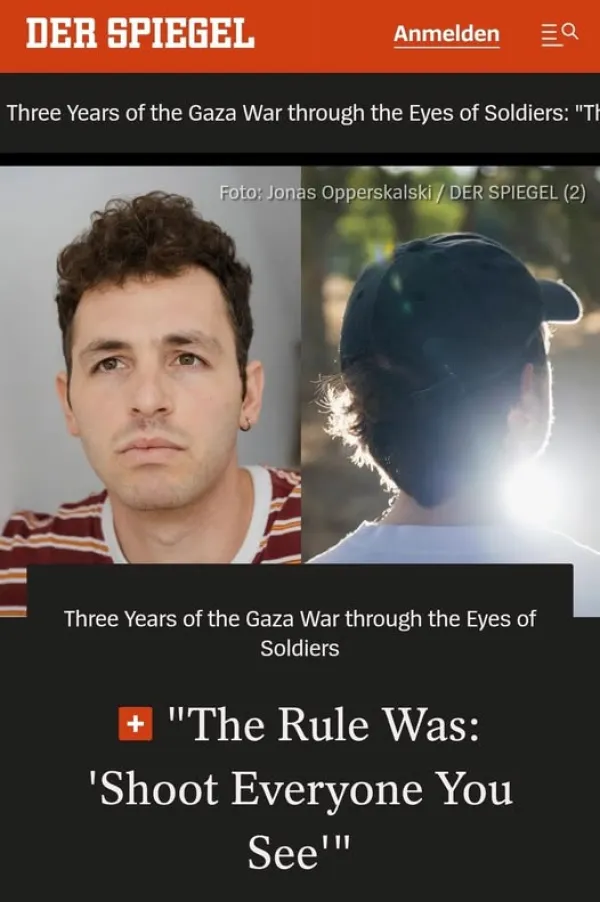
10 Israeli soldiers to the Spiegel: "The rule was, shoot everything you see". 𝗧𝗲𝗻 𝗜𝘀𝗿𝗮𝗲𝗹𝗶𝘀 𝘄𝗵𝗼 𝘀𝗲𝗿𝘃𝗲𝗱 𝗶𝗻 𝗚𝗮𝘇𝗮 𝗵𝗮𝘃𝗲 𝘁𝗼𝗹𝗱 𝗗𝗲𝗿 𝗦𝗽𝗶𝗲𝗴𝗲𝗹, 𝗚𝗲𝗿𝗺𝗮𝗻𝘆'𝘀 𝗯𝗶𝗴𝗴𝗲𝘀𝘁 𝗻𝗲𝘄𝘀 𝗺𝗮𝗴𝗮𝘇𝗶𝗻𝗲, 𝘄𝗵𝗮𝘁 𝘁𝗵𝗲𝘆 𝘀𝗮𝘄 𝗮𝗻𝗱 𝘄𝗵𝗮𝘁 𝘁𝗵𝗲𝘆 𝗱𝗶𝗱. Photo credit: Der Spiegel
Ten Israelis who served in Gaza have told Der Spiegel, one of Germany's leading news magazines, what they witnessed and what they did. Some fought on the ground, others operated drones or selected targets for airstrikes.
The interviews were facilitated in part by Breaking the Silence, an Israeli organization that collects testimonies from soldiers about their military service and alleged misconduct.
Der Spiegel cross-checked the accounts against other testimonies and independently verifiable information and said it considered them credible. Nine soldiers spoke anonymously. Only one, Yuval Green, agreed to be identified by name.
Most said they would refuse to return to Gaza, although one had recently been redeployed there.
The ceasefire agreement took effect on October 10, 2025. A year later, Israeli forces still controlled approximately two-thirds of Gaza, and Israeli strikes continued.
Here are the ten soldiers' accounts, as reported by Der Spiegel.
Read the original Der Spiegel investigation
TEN SOLDIERS. TEN TESTIMONIES.
1. David, infantry reservist. His unit opened fire on unarmed men on bicycles, men loading a truck, and others simply walking past. Several people were killed. His commander subsequently told the soldiers the dead were Hamas members in disguise. David described how quickly the killing became routine.
2. Yair, drone pilot. He said that, for much of the war, drone strikes could be approved even when as many as 20 civilian deaths were anticipated. Authorization sometimes came within seconds. He also described a colleague who wanted to take his personal anger out on the enemy.
Here is a recent clip form October 4, 2026 Showing the most moral army in the world in action, how they treat a disabled person in a wheelchair. Please, don't be silent. Be the voice of the oppressed!
https://x.com/Davam_Gazze/status/2106866415798022236?a=iKZ9DfUHLRwkFwdkhbc&s=20
3. Yuval Green, paratrooper. He described an inflammatory speech delivered to his unit by a veteran associated with the 1948 Deir Yassin massacre. Green also recalled his commander saying that a child inside a house where a terrorist was located should be killed along with the suspected terrorist. Green refused an order to burn down a Palestinian family's home and left the following day.
4. Yaakov, reservist. He said his brigade killed between 160 and 170 people in 80 days, although only one was suspected of carrying a weapon. In one incident, an officer dismissed a drone pilot's concern about a man hanging laundry on a rooftop, saying Palestinian men did not hang laundry and that the man must be a spotter. A tank fired. Twelve members of a family were subsequently reported killed. Yaakov believed they were responsible.
5. Tomer, deputy company commander. After more than 350 days in Gaza, he said he had barely seen a Hamas fighter with his own eyes. He described a subordinate refusing water to an elderly Palestinian woman carrying a white cloth. Tomer gave her water himself. He also witnessed soldiers sending a Palestinian man into a tunnel ahead of them.
6. Noam, military intelligence. His job involved selecting homes for bombing. He said his commander told the team that the Chief of Staff had accepted the possibility of 300 civilian deaths in a strike targeting a Hamas commander in Jabalia on October 31, 2023. Airwars documented between 126 and 143 civilian deaths in the Jabalia strikes that day.
7. Shaul, army medic. He described seeing young Palestinian men blindfolded, bound and stripped to their underwear before being sent into tunnels ahead of Israeli troops. Soldiers reportedly called them "mosquitoes." Shaul said he was disturbed that nobody seemed to object.
8. Omri, military intelligence. He said he repeatedly heard estimates of more than 100 civilian deaths being accepted in individual strike assessments. He remains troubled by what happened and by his own involvement.
9. Tal, soldier. He described the August 25, 2025, Israeli attack on Nasser Hospital, which killed 22 people, including five journalists. He disputed the military's initial characterization of some of those killed as Hamas members. He said the incident was what finally compelled him to break his silence.
The story about murder of five journalists by the IDF in their tent outside Nasser Hospital was published in the Columbus Free Press. See the link below.
Mahmoud Israel murdered Anas Al-Sharif for the crime of being a journalist
10. Itay, conscript. He recalled that during the first weeks of the war, his unit operated without meaningful rules of engagement. As he put it: "The rule was: Shoot everyone you see." He also described the use of a Palestinian man to enter houses ahead of Israeli soldiers, exposing him to danger.
THE ISRAELI MILITARY'S RESPONSE
The Israeli military told Der Spiegel that it had never authorized an attack expected to kill 300 civilians, did not target men simply because they were of fighting age, and prohibited the use of human shields.
Those denials deserve to be reported. But they do not erase the testimony of ten Israelis who described what they witnessed during their service.
THE DEAD CANNOT TESTIFY
Behind every number in this story is a person who had a name.
The men on the bicycles. The man hanging laundry in the morning sun. The twelve members of one family. The Palestinian man sent into a tunnel ahead of armed soldiers, whose fate remains unknown.
For three years, Palestinians have told the world what was happening to them. Now, Israeli soldiers who served in Gaza are describing what they witnessed and, in some cases, what they participated in.
More than 74,000 Palestinians have been reported killed in Gaza, according to the Gaza Ministry of Health. Ten Israeli soldiers have now spoken about their experiences.
The dead cannot testify. But the soldiers who witnessed their deaths are speaking.
Please don't be silent. Be a voice for the oppressed.
Mahmoud El-Yousseph is a Palestinian freelance writer and retired U.S. Air Force veteran. He writes about U.S. foreign policy, Middle Eastern affairs, and justice.